SA Cladding | Adelaide CFC & Hebel Specialists
CFC Cladding vs Hebel: Which Is Right for Your Adelaide Home?
A straightforward, side by side comparison of Adelaide’s two most popular modern wall systems, covering durability, cost, installation and insulation.
If you are planning a new build, extension or facade upgrade in Adelaide, your shortlist has probably narrowed to two names: CFC and Hebel. Both are modern, durable and hugely popular across South Australia. However, they are very different materials, and the right choice depends on what your project needs most.
What This Guide Covers
First, we explain what CFC sheets and Hebel panels actually are. Next, we compare the two on durability, cost, installation speed and insulation. Finally, we share our honest recommendation for Adelaide projects. By the end, you will know exactly which system suits your build, or whether a combination is the smarter answer.
What Is CFC Cladding?
CFC stands for compressed fibre cement. The sheets are made from cement, cellulose fibres and sand, pressed together under high pressure. As a result, the finished sheet is dense, hard and very stable. In fact, that compression is exactly what separates CFC from lighter fibre cement boards.
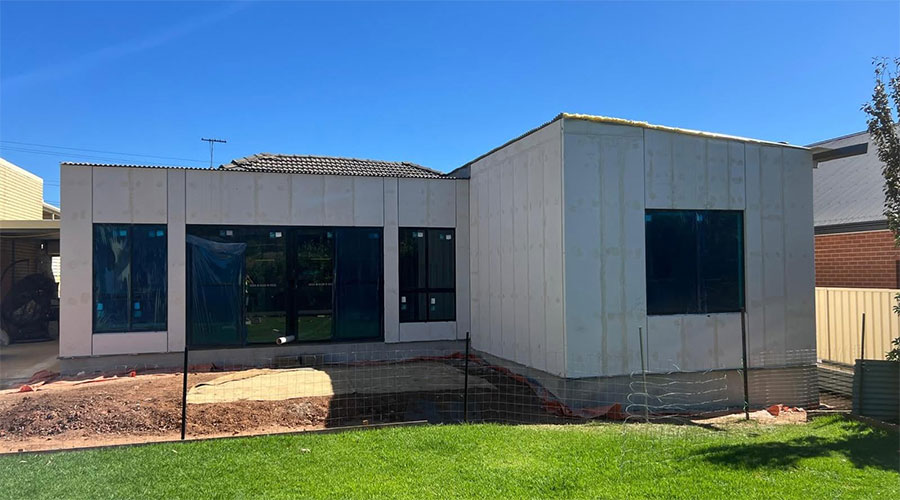
In short, CFC cladding is a high-density compressed fibre cement sheet fixed to a building’s exterior. It resists moisture, rot, fire and termites, holds crisp architectural lines, and accepts paint or render for a clean, modern finish.
Because of these qualities, CFC suits sheeted facades, upper storeys, feature entries, parapets, soffits and commercial exteriors. SA Cladding supplies and installs compliant CFC systems across Adelaide. To see the full service, visit the Adelaide CFC cladding page.
What Are Hebel Panels?
Hebel is a brand of autoclaved aerated concrete, usually shortened to AAC. The panels combine sand, cement, lime, gypsum, water and an expansion agent, then cure under high-pressure steam. During curing, millions of tiny air pockets form throughout the material. Consequently, the finished panel is solid yet remarkably light.
In short, Hebel panels are lightweight aerated concrete panels fixed to the building frame and finished with render or paint. They deliver a solid feel, strong built-in insulation and excellent fire performance, and they install far faster than traditional masonry.
Thanks to those air pockets, Hebel performs strongly on thermal comfort, sound and fire resistance. It is a favourite for whole-of-home walls, townhouses and commercial builds. To explore the options, see SA Cladding’s Adelaide Hebel and cladding services.
Durability and Weather Resistance
Adelaide throws hot, dry summers, winter rain and bushfire risk at every exterior. Fortunately, both materials are built for exactly these conditions, though each protects your home in a slightly different way.
CFC: Dense and Impact Tough
Because the sheet is pressed under high pressure, CFC is hard, stable and impact resistant. It shrugs off moisture, rot, termites and everyday knocks, which makes it ideal for entries, garage fronts and street-facing walls. Moreover, it holds its shape through heat without warping or swelling.
Hebel: Solid, Stable and Non-Combustible
Hebel is an inorganic AAC product, so it does not burn, rot or attract pests, and it will not warp or twist over time. Its surface is softer than CFC, however, which means the coating system does the protective work against weather and knocks. Properly coated, it delivers decades of reliable service.
So which is more durable? Honestly, both perform very well when installed and finished correctly. CFC has the edge for impact resistance in high-traffic areas, while a well-coated Hebel wall is superbly stable for the long haul. In practice, workmanship matters more than the badge on the panel. That is exactly why correct fixing, sealing and finishing are so important.
Cost Comparison
Cost is usually the first question we hear, and the honest answer is that it depends on your design. The two systems spend money in different places, so the table below shows where each dollar goes.
| Cost Factor | CFC | Hebel |
|---|---|---|
| Material Supply | Sheets are typically the more affordable component | Panels typically cost more to supply |
| Installation Labour | More time on cutting, jointing and detailing | Fast panel coverage keeps labour hours down |
| Finishing | Painted, or rendered for a seamless face | Coated with a render system, then painted |
| Ongoing Maintenance | Low; an occasional wash and repaint | Low; an occasional wash and recoat |
| Installed Cost Overall | Mid-range; driven by design and detailing | Mid-range; often lands very close to CFC |
As a general guide, both systems sit in a similar mid-range bracket: more than basic sheet cladding, yet well below double brick or natural stone. However, the final figure always depends on wall area, site access, detailing and your chosen finish. Consequently, comparing generic square-metre rates can be misleading.
The most reliable approach is an itemised quote based on your actual plans. For a clear, no-obligation comparison of both systems on your project, request a free quote from SA Cladding.
Installation Speed and Process
How each system goes onto the wall affects your schedule, your budget and the final finish. Here is how the two processes compare on site.
How CFC Is Installed
- ▶Sheets are cut, then fixed true and level to a prepared frame
- ▶Joints are expressed with trims or flush set for a seamless look
- ▶Cutting is managed with dust control and safe work practices
- ▶Junctions are sealed, then the face is painted or rendered
How Hebel Is Installed
- ▶Panels are fixed vertically to the frame over a batten system
- ▶Adhesive joints create a solid, uniform wall with no visible lines
- ▶Openings and services are cut in quickly and cleanly
- ▶The wall is coated with a render system, then painted
So which is faster? Generally, Hebel covers large wall areas more quickly, because a single 3-metre panel replaces roughly 90 bricks of coverage. CFC is also efficient, although the jointing and finishing stages take a little more time. Either way, both systems progress far faster than traditional brickwork.
Importantly, neither material is a DIY product. Correct fixing, jointing and sealing determine how the wall performs for decades, so licensed installation is essential. SA Cladding installs both systems to Australian Standards, and our Hebel supply and installation service handles measure, supply, install and finishing with one team.
Insulation and Thermal Properties
Insulation is where the two materials differ most. Hebel’s millions of tiny air pockets give it genuine built-in thermal resistance. As a result, a Hebel wall helps keep interiors cooler through Adelaide’s summer heat and warmer through winter, which lowers heating and cooling costs. Those same air pockets also dampen sound, and that makes a noticeable difference near busy roads.
CFC takes a different path. Because the sheet is thin and dense, it offers little built-in thermal resistance on its own. Instead, a CFC wall relies on the insulation fitted within the wall frame. Designed correctly, the complete system still meets modern energy standards. Furthermore, that same density helps the wall block outside noise effectively.
In short, Hebel leads for built-in thermal and acoustic comfort, while CFC performs well as part of a properly insulated wall system. Therefore, if year-round comfort is your top priority, Hebel starts ahead. If crisp detailing matters more, CFC with quality frame insulation remains an excellent choice.
Our Recommendation for Adelaide Projects
So which should you choose? Our honest answer is that it depends on the project. After more than five years installing both systems across Adelaide, here is how we typically advise homeowners and builders.
Choose CFC When…
- You want a crisp, sheeted facade with expressed joints or a flush finish
- The area takes daily knocks, like entries, garage fronts and street-facing walls
- You are detailing parapets, upper storeys or feature sections
- Impact resistance and sharp architectural lines are the priority
Choose Hebel When…
- You want solid, quiet walls with built-in thermal comfort
- The schedule is tight and large wall areas need to go up fast
- A rendered finish across the whole home is the design goal
- You are building near busy roads or want cooler summer interiors
Importantly, this is not always an either-or decision. In fact, many Adelaide projects combine the two: Hebel for the main walls, with CFC for feature areas, parapets and high-traffic sections. Consequently, you get the comfort of Hebel where you live and the toughness of CFC where it counts.
Every site, budget and design is different, so tailored advice beats a rule of thumb every time. For a clear recommendation on your specific project, contact the SA Cladding team for a free consultation and itemised quote.
FAQs: CFC vs Hebel
Which is cheaper, CFC cladding or Hebel?
Neither has a clear cost advantage on every project. CFC generally involves lower sheet costs but more labour on jointing and finishing, while Hebel panels cost more to supply but cover walls faster. As a result, installed costs often land close together. For an accurate comparison, request an itemised quote based on your actual plans, wall areas and finish selections.
Is Hebel better insulated than CFC?
For built-in insulation, yes. Hebel’s aerated structure gives it genuine thermal and acoustic resistance on its own. CFC is dense rather than insulating, so it relies on the insulation within the wall frame. However, a well-designed CFC wall system still meets modern energy standards, and its density helps block outside noise as well.
Can I use CFC and Hebel together on one project?
Absolutely, and many Adelaide builds do exactly that. A common approach uses Hebel for the main walls and CFC for feature sections, parapets and high-traffic areas. SA Cladding supplies and installs both systems to Australian Standards, so we can design and deliver a combined solution with one licensed team.
Weighing Up CFC and Hebel for Your Adelaide Project?
SA Cladding supplies and installs both CFC and Hebel wall systems for homes and commercial buildings across Adelaide. Family owned, fully licensed, and locally experienced. Get expert advice and a free, obligation-free quote.