Section 01
What Are Hebel Blocks?
Hebel blocks are masonry units made from Autoclaved Aerated Concrete (AAC). They are manufactured by combining sand, cement, lime, gypsum, water, and an expansion agent, poured into moulds, cut to block dimensions, and cured under high-pressure steam. This autoclave process produces a cellular concrete structure that is lightweight, thermally efficient, fire-resistant, and easy to work with on site.
Block Hebel is laid course by course in a similar method to conventional brickwork, using a thin-bed adhesive mortar rather than standard sand-and-cement mortar. This jointing method creates tight, consistent coursing and reduces thermal bridging between courses.
Because Hebel block is approximately 80% lighter than conventional clay brick, it is faster to handle and install on site, reducing overall labour costs and supporting tighter project timelines.
Faster handling and installation on site, with reduced structural load transferred to walls, columns, and footings.
Key Characteristics
Section 02
What Are Hebel Panels?
A single 3-metre Hebel panel is equivalent to approximately 90 bricks in wall coverage, delivering major productivity gains for builders on large facades.
Panel Advantages
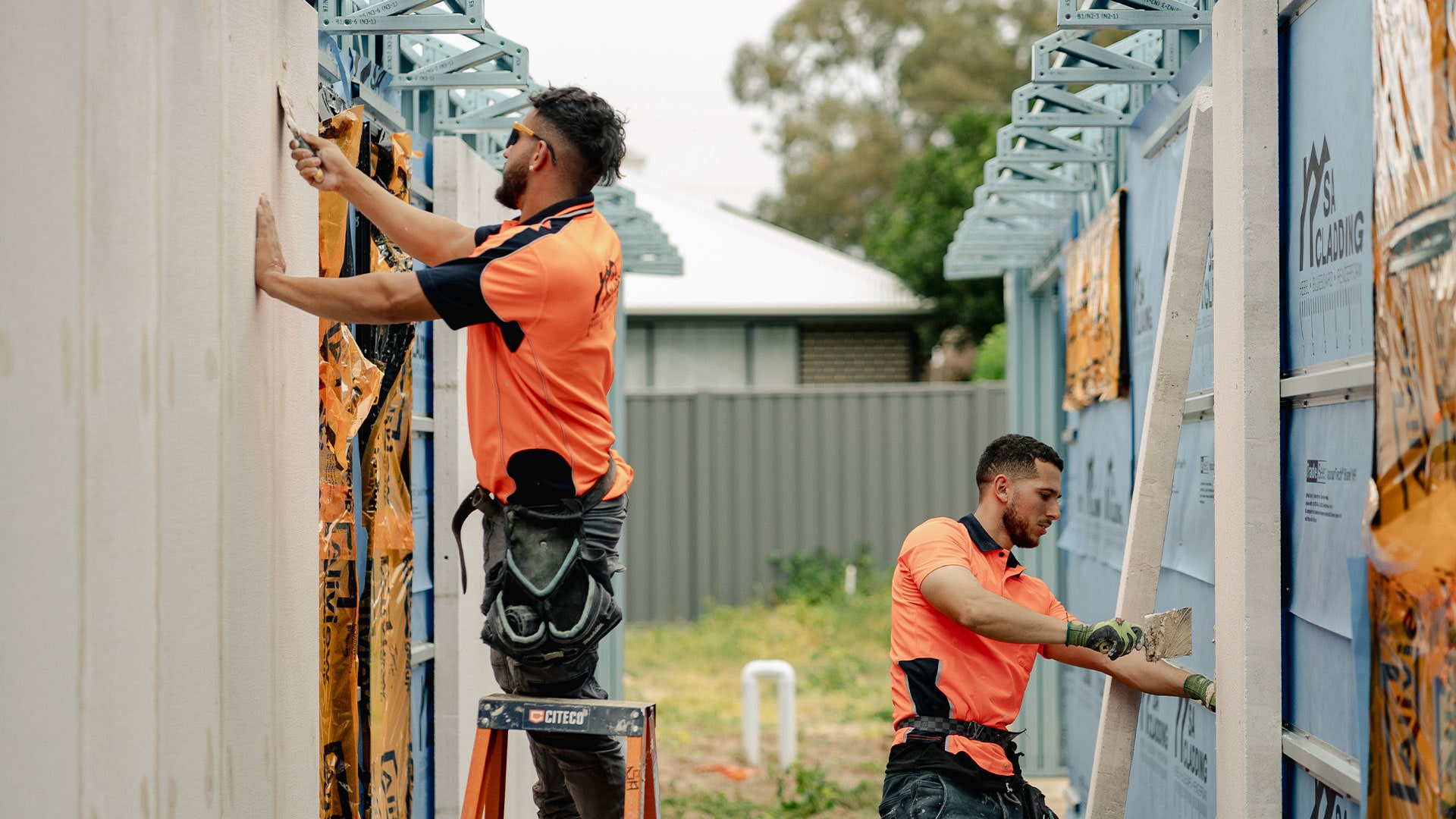
Hebel panels are larger, flat AAC elements that are steel-reinforced for added strength and structural capacity. Unlike blocks, which are laid individually in courses, Hebel panels are installed vertically or horizontally as a system, covering large wall areas quickly. The steel reinforcement inside each panel allows them to span between supports, carry lateral wind loads, and meet structural performance requirements for external facades and walling systems.
Hebel panels are manufactured in custom lengths to suit project dimensions, minimising waste and reducing the need for cutting on site. A single 3-metre Hebel panel is equivalent to approximately 90 bricks in coverage, a significant productivity advantage for builders working on large facades or multi-unit residential projects.
Panels are the primary product used for external Hebel cladding, facades, and fencing on residential and commercial builds. They are also used in flooring applications. For more detail, see SA Cladding’s Hebel flooring page.
SA Cladding installs Hebel panels across Adelaide as part of both its installation-only and full supply and installation service. For a complete overview, visit the Hebel services Adelaide page.
Section 03
Hebel Blocks vs. Panels: Key Differences
While both Hebel block and Hebel panel products are made from the same AAC material, they serve different purposes and are installed using different methods.
| Attribute | Hebel Block | Hebel Panel |
|---|---|---|
| Form | Individual masonry unit | Large reinforced sheet |
| Reinforcement | None (standard masonry unit) | Steel-reinforced throughout |
| Installation | Laid in courses with thin-bed mortar | Installed vertically or horizontally as a panel system |
| Applications | Walls, fencing, retaining walls | External facades, Hebel cladding, flooring, fencing |
| Sizing | Standard block dimensions | Available in custom lengths to suit project |
| Coverage | Single block (600 x 200mm face) | Up to 90-brick equivalent per 3m panel |
| Spanning | Requires supporting structure | Can span between supports (reinforced) |
Section 04
Sizes, Formats, and Specifications
Hebel Block Sizes
Hebel blocks are available in a range of thicknesses to suit different wall types and performance requirements. Common thicknesses include 75mm, 100mm, 150mm, and 200mm, with a standard face dimension of 600 x 200mm. Thicker blocks are typically specified where higher thermal mass, acoustic separation, or structural performance is required. For external walls in Adelaide’s climate, a 150mm or 200mm block is commonly used to maximise thermal performance.
Hebel Panel Sizes
Hebel panels are available in standard widths and a range of thicknesses, typically from 75mm to 200mm depending on the application. Panels can be ordered in custom lengths to suit project-specific measurements, reducing waste and cutting on site. For fencing and retaining wall applications, the thickness and reinforcement specification will depend on the height and loading of the wall. For retaining wall guidance, see the Hebel retaining walls Adelaide page.
Common Panel Specs
Section 05
Common Applications for Hebel Blocks and Panels
Both block and panel Hebel products are used across a wide range of residential and commercial applications in Adelaide and across South Australia.
Residential Construction
Hebel is widely used in residential builds for external walls, facades, internal partitions, and upper-level flooring. A Hebel house offers improved thermal comfort, reduced structural load, and strong fire and acoustic performance compared to conventional brick construction.
Commercial Construction
In commercial builds, Hebel panels are commonly specified for external facades, fire walls, and separating floors in multi-unit developments. Speed of installation and reduced structural load are key advantages for commercial builders on tight programs.
Multi-Storey Buildings
Hebel’s lightweight properties make it well suited to multi-storey residential and commercial buildings where reducing load on the structural frame is a priority. Panels can be used for both external facades and separating floors between levels.
Fencing and Boundary Walls
Hebel fencing is a popular alternative to colorbond or brick fencing in Adelaide. It provides a clean, modern finish, good acoustic separation from neighbours and road noise, and requires no ongoing maintenance once rendered and painted.
Fire Walls and Party Walls
Both Hebel blocks and panels are non-combustible and are widely specified for fire walls and party walls requiring fire resistance level (FRL) compliance under the National Construction Code.
Hebel Cladding
Hebel cladding refers to Hebel panels fixed to the external face of a building as the primary wall system. Panels are rendered and painted to produce a modern, low-maintenance facade for new builds and re-cladding projects across Adelaide.
Section 06
How SA Cladding Supplies and Installs Hebel Products
SA Cladding is a family-owned Adelaide business with over five years of experience in Hebel supply and installation across residential and commercial projects. The team offers a full-service solution covering site appraisal, product selection, supply, installation, rendering, and painting.
SA Cladding’s installers are fully licensed and insured, working to Australian Standards with on-site supervision and documentation across every project.
Initial Consult and Advice
SA Cladding reviews your plans and project requirements, then recommends the appropriate Hebel product, thickness, and installation method for the application.
Site Measure and Detailed Quote
A site visit confirms measurements, structural conditions, access, and scope. An itemised quote is prepared with no hidden costs or surprises.
Supply and Installation
Hebel materials and sundries are delivered to site and installed by SA Cladding’s accredited installers, working to builder specifications and site schedules.
Finishing Trades
Rendering and painting are coordinated by SA Cladding to complete the system and deliver a clean, consistent finish ready for handover.
Quality Check and Handover
A final inspection is carried out against the required standards. The site is left clean and tidy, with guidance on care and maintenance provided.
Frequently Asked Questions
FAQs
What is the difference between a Hebel block and a Hebel panel?
Hebel blocks are individual masonry units laid in courses using thin-bed mortar, similar to brickwork. Hebel panels are larger, steel-reinforced sheets installed as a panel system, covering greater wall area more quickly. Blocks are suited to masonry wall construction, while panels are typically used for external facades, Hebel cladding, and flooring systems. Both are made from AAC and offer the same core thermal, acoustic, and fire benefits.
What sizes do Hebel blocks come in?
Hebel blocks are available in a range of thicknesses, commonly 75mm, 100mm, 150mm, and 200mm, with a standard face dimension of 600 x 200mm. The appropriate thickness for your project depends on the wall type, structural requirements, and performance specifications. SA Cladding can advise on the correct product at quote stage.
Can Hebel panels be used for external cladding?
Yes. Hebel panels are one of the most commonly specified external cladding products in residential and commercial construction across Australia. Panels are fixed to a structural frame, rendered, and painted to produce a durable, low-maintenance facade. SA Cladding installs Hebel cladding across Adelaide for both new builds and re-cladding projects.
How do I order Hebel blocks and panels in Adelaide?
Contact SA Cladding on 0434 680 620 or via the quote form on this page. The team will arrange a site visit, confirm the correct product specification for your project, and manage supply and delivery as part of the full installation service.
Ready to Get Started?
SA Cladding provides obligation-free quotes for Hebel block and panel supply and installation across Adelaide.
Contact SA Cladding
Talk to the Team
Have a project in mind? Contact SA Cladding for an obligation-free, itemised quote.
4/7 Kester’s Road, Para Hills SA 5096